Wednesday, 11 January 2012

The Paddling Tree


There are many firsts in our life experiences that will always stick with us. Most of us have at least a few memories of our first school, perhaps even of our first teacher, and memories of our first best friend. Of course there is the over romanticised first kiss, which never lives up to all the hype of movies and story books. The first car (which is a far clearer memory for most men than their first romance J), first job, first house/flat..... While all these memories will have varying degrees of importance or clarity for everyone, they all pale into insignificance for many paddlers when held against the memory of their first paddling experience. Every paddler remembers their first time on the water, vividly and usually fondly no matter how early the experience, or even if it was not such an enjoyable introduction. For each of us, there is something undefinable that has drawn us to the water, and that keeps us coming back to it. There are people who paddle, and there are Paddlers. For the Paddlers, it is not just a hobby or a fun thing to do on a sunny day, it is a way of life.  When asked by non paddlers (yes, there are such unenlightened, deprived people out there) the question “Why do you paddle?” It is often difficult to come up with an immediate answer. The first response is usually a blank gaze as the Paddler ponders “Why are they asking me such a dumb question?” It’s almost as if someone has just asked “why do you breathe?”
It doesn't get any better.....How do you explain this to a non paddler?
Ask people what they love most about paddling and you will get a broad range of answers. Tranquillity, excitement, exercise, solitude, friendship, challenges, relaxation, adrenaline, escape, nature..... the list goes on. For me, it is all of the above plus some, but one of the things I love most about paddling is the incredible diversity. There are so many ways to enjoy kayaking there is just no way it can ever get old. Unfortunately, it is that very diversity that causes the most trouble in the paddling community.  It is a sad reality that for many, diversity has come to mean divisiveness.
 It is human nature to categorise and label, to judge and compare. Most paddlers like to place themselves in a particular niche. We give each of these niches a label, and with a label comes a sense of identity. Now we have different groups of paddlers, all in their own categories, all wanting to compare themselves against others. To many, the paddling world is kind of like a tree, each person visualises their own particular niche as inhabiting one of the highest branches allowing them to look down upon the other paddlers. And so we have sea kayakers looking down on flat water paddlers, surfers & rock gardeners looking down on tourers, racers looking down on recreational paddlers, white water in a tree all of their own (probably upside down, hanging from their toes and laughing), SOTs universally sneered at, and everyone thinking the Greenland following are just crazy. Then there’s the Expeditioners who many treat with a kind of hushed reverence, perhaps looking upon them as some strange specimen that has left the tree altogether and are performing the unique marvel of walking on the ground.
The trouble is, once you have given yourself a label and a niche, it is hard to step outside of the perceived boundaries that create that identity, whether it is stepping outside your comfort zone, or just being open to new opportunities and experiences. To limit yourself to one narrowly defined category is to miss some amazing opportunities.  I have had so many unforgettable experiences in paddling, many of which I would have missed if I chose to limit my paddling experiences to just one field. Each different environment has its own beauty and excitement;
On Flat Water there is the unique beauty of gliding across mirror smooth water, your boat cutting silently through the reflected images of trees, cliffs and sky. There is the wildlife, a flat water trip is like bush walking on water, with the added advantage of getting far closer to the wildlife than possible on land – I have had amazing encounters with Wombats, Wallabies, Kangaroos, Echidnas, snakes, Goannas, Water Dragons and a host more, not to mention the birds – Wedge Tailed Eagles, Sea Eagles, Swans, Ducks, Cormorants, Lyre birds, Bell birds, Lorikeets, Rosellas, Kingfishers and many more (there was also an encounter with a charging bull that gave a particular spot on a river the nickname of ‘Bull Bend’ but perhaps a story for another timeJ). One of the most unforgettable flat water trips I have had was Lake Towada – an incredibly beautiful lake in the crater of a volcano in Japan. With clouds and mist settling on the surrounding peaks and the vivid green of the surrounding bush, we were in a world of our own as we paddled on the crystal clear water, definitely a destination I would love to return to.
On a windy day, serenity is replaced by excitement, surfing wind driven waves across a lake or putting on the power and pitting yourself against the wind, many people think I’m crazy, but I love paddling into a head wind!
Paddling with friends on Lake Towada, the rain added it's own magic to the day, surrounded us with cloud and mist.
The sea has its own mystical draw for many of us and has so much to offer. I love feeling the rhythm of the ocean swell, or the excitement of punching through a wave, being slapped in the face by spray, there is the adrenaline of surfing or the serenity of cruising on a calm day. I have to admit, I value my boat too much to have tried rock gardening, though I can easily see where the thrill lies for those who do it. I have had the joy of paddling with dolphins, seals, sea turtles, sharks, stingrays, stingarees and an amazing array of water birds. The experience of our boats being escorted by a pair of fairy penguins for about 1km one day was an unforgettable one, as was having dolphins twisting and turning upside down as they passed under our boats close enough to touch, or drifting over majestic sting rays – 5-6 feet across gliding silently through the water. Paddling along towering sea cliffs or over reefs teeming with an incredible abundance of life, or sitting alone, a tiny speck on the ocean looking out to the horizon and knowing there is nothing between yourself and New Zealand over 2000 kms away............ Ocean paddling can be an incredibly humbling experience.
Wayne resting in the shelter of Tollgate Island - A really fun day with
3 meter swell,but otherwise calm, it felt like paddling on a roller coaster.

Of course there is the exhilaration and adrenaline of white water, planning your course, guiding your boat through an exciting rapid and the thrill of being upright at the end. I remember a hilariously fun day many, many years ago when, bored with the grade ones and occasional twos on the river we were paddling, we decided instead to paddle Up each of the rapids. Lining up on each one, picking our route as we approached, then paddling like crazy to inch our way up the rapid and into calm water again. We got some rather strange looks from other paddlers that day, but we had a hell of a lot of fun J Kayaking a river in flood in Borneo tested, and found my limits in white water (a poor choice of guide and very unsuitable boats certainly added an element to that experience, as did the flooding which amped the river up a bit from our expectations), I did make it to the end, a little shaken perhaps, and can’t say I regret the trip having been given the chance to push myself and test my limits, but I can definitely say I prefer rafting to kayaking if we’re going for adrenalin. My hat does go off to the seemingly crazy paddlers who have developed the skills and experience to tackle rapids and drops that the rest of us would see as suicidal.
The Hawkesbury Canoe Classic, (a 111km ultra marathon on a tidal affected river) has given me a great appreciation for long distance events and I have a wish list of events I would love to tackle when time, finance and fitness allow, the fact that many of these events regularly have participants in their 60s inspires me and reminds me that I may not make it to these events as soon as I would like, but it will never be too late to reach for those goals. The Hawkesbury is held at night which adds an extra dimension to the mental endurance needed in this race as you find yourself spending many hours alone on the river, often in complete darkness. I am hoping the trials I have faced on this river will help prepare me for some of the tougher events on my list.
With our strange 'rubber hoodies' and an obsession with rolling,
for some reason other paddlers find the traditional crowd a bit odd.
Then there is the Greenland paddling skills, those who haven’t been bitten by the Greenland bug usually think we’re a strange bunch, it is hard for them to understand, and hard for us to explain. But for many of us, there is a strong draw to history, culture and tradition. Learning about the history and culture that created the kayak adds depth and richness to our paddling experience. I have a strong respect for tradition and believe the origins of any skill should be acknowledged. Kayaking originated in Greenland and the Arctic circle, we may have changed and adapted it to suit our recreational uses, but I still believe in giving credit where it is due, to do otherwise is to rob a people of an important part of their identity.  It may be pointed out by some that we no longer use kayaks to hunt seal or whales, I still find the traditional skills fascinating and a lot of fun to learn, and the rolling is unbelievably fun J.

As I have said, there is an incredible diversity in the kayaking world, I consider myself fortunate that I have had the chance to experience so much of what it has to offer. I am certainly not an expert in any field, but simply have a love of paddling. Even though there are some areas of paddling that may hold less appeal for me, or some that are beyond my skills, I like to think that we are all Paddlers. We may find different ways to enjoy the water, and we all have differing skills or preferred experiences, but we are all united by one thing – we are passionate about paddling. The water is a shared passion between us all whether it be sea, river or lake, and whether the paddlers themselves are rough water thrill seekers, calm water cruisers or somewhere in between.
So maybe it’s time to climb out of the tree and really look at other paddlers, not as someone to compete with or compare against, but as a fellow paddler who shares the same passion for the water. Stepping outside your comfort zone can add so much more to your paddling, for many this simply means being open minded to other paddlers, or other types of paddling. Next time you start a conversation with a paddler, don’t start with ‘what type of paddling do you do?’ Try ‘What do you love about paddling?’ You may find they enjoy all the same things you do, just in a different way.

Friday, 23 December 2011

           A Kayaker's Kristmas

     The time's drawing nigh to load Santa's sleigh,
     But it seems there's a problem, by his look of dismay.
     He's checking things over, to be sure nothing's missed,
     But it's becoming apparent, that some imp's changed his list.

     No teddies, no dolls, no games, bikes or balls,
     In fact, he sees none of his usual haul.
     Puzzled he stands and surveys the collection,
     Trying to make sense of this strange selection.

     Tight rubber 'skirts', an odd dress called a 'cag',
     Bright coloured ropes coiled neatly in bags.
     Gloves, vests and hoods made of black neoprene,
     His cheeks glowing red as he ponders that scene.

     A selection of kayaks, all shiny and sleek,
     A Greenland style paddle looks sexy and chic.
     Dry-bags and pumps and a new PFD,
     A stranger collection, he never did see.

     Meanwhile, the Paddlers are tucked in their beds,
     Waterborne visions adrift in their heads.
     Their booties are hung (they've been freshly cleaned),
     The room subtly scented with wet neoprene.
     And on each sleeping Paddler, a secretive smile,
     They know this Christmas will be - 
                   Kayaker Style.
                                                      Mel Hanley


Wishing everyone a Merry Christmas and Happy Paddling  :)

Wednesday, 7 December 2011

GUTS 2011. Our Japanese Adventure.

When I first picked up a Greenland Paddle, I could never have guessed where that simple step would lead me. History and tradition have always had a strong draw for me, and of course taking that first step not only added a greater depth to my kayaking experience, it also hooked me on learning more about the history and traditions of kayaking and its origins in Greenland and the Arctic Circle. The greatest surprise has been the many wonderful people I have met on the journey so far. The Greenland Bug has caught on world-wide and there are so many people out there willing to share their passion and their experiences freely with others. Our recent trip to Japan gave me an even greater appreciation for this.
After our adventures in Canada, we returned home via a little detour to Japan. Eiichi Ito, the president of Qajaq Japan, had kindly extended an invitation for us to attend their annual event – GUTS (Greenland Users Trial Stages). I have visited Japan a number of times, for martial arts events, and as an assistant to youth delegations through our community’s Sister City Link. Japan is an amazing country and its culture, history and traditions have held a fascination for me since I was a teenager. It was an opportunity we couldn’t pass up.
A long flight, a train and a Shinkansen (bullet train) later and we were finally at our destination
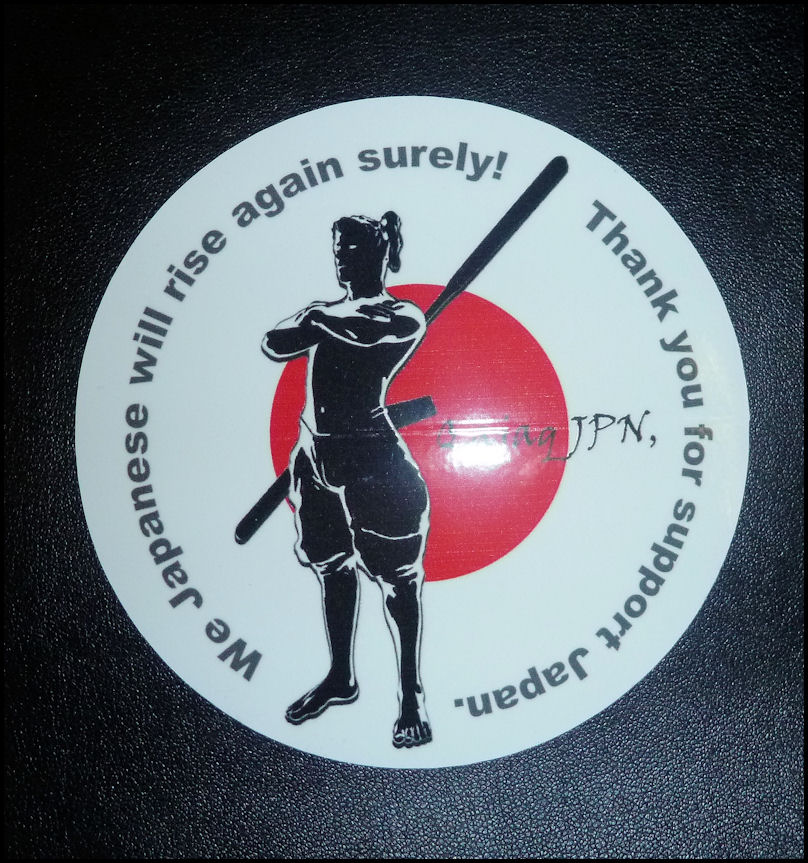
Stickers produced by Qajaq Japan to raise funds
for the victims of the earthquake & tsunami.
After the earthquake and Tsunami that struck Japan in March this year, GUTS2011 was made a charity event, raising desperately needed funds for the victims of the tragedy, making their theme for this year: Coexistence, Kayak and Sea. The culture and identity of Japan is so closely interwoven with the surrounding sea it is impossible to separate them. Those who spend time with the sea, either for pleasure or for work, gain a healthy respect for the power of the ocean, but when something this devastating strikes, it is hard to imagine living in harmony with such a force. The Sea surrounds us and supports us, it provides for us and, for an island nation, offers protection. It is all too easy to forget how important it is when it has delivered such a terrible blow to the very people who depend on it.
During the event, there was a talk and slide show given by Soma-San who worked as a volunteer in some of the stricken areas. To see even a fraction of the devastation witnessed by these people is heart breaking, to volunteer in such a situation takes enormous courage and strength and I greatly admire Soma and all the people who worked so hard to help those in need. The catch cry taken up by volunteer groups and fundraisers throughout Japan is the word “Kizuna” which in a rough translation means ‘strong bonds of friendship’, and Kizuna was a word we used often through the weekend, I felt honoured to be friends with such a great group of people.
Our bedroom for a few days - we stayed in the
library, while Helen had the principal's office.
With two typhoons sitting off the coast, we saw a lot of rain. Some plans were changed, but everything was kept rolling along smoothly. We stayed in an old school which was about 125 years old. After being closed down when it was down to only eight students, it is now rented from the local government and is the sight of a Nature School. Making it more interesting, all the old school equipment is still in place, complete with student’s artwork and photos on the walls, giving the impression that at any time a bell may ring and a crowd of laughing children are going to appear out of nowhere to attend their classes. We were told that sometimes people who attended here in their childhood still come back to visit and see their old school, revisiting fond memories of their school days.
Qajaq Japan has left its stamp here, with skin on frame kayaks suspended from the ceiling and a classroom converted to a boat building workshop, complete with notations and instructions on the blackboard. The gymnasium also made an excellent place to dry our gear on ropes stretched across the hall, and provided an indoor lecture room when the weather took a turn for the worse and one of our lessons became a theory class instead of braving the weather to get on the water again.
Beautiful Skin On Frame kayaks under construction.
The instructor for the event, and judge for the competition was Helen Wilson, who we had met just two weeks earlier at Thunder Bay in Canada. Lessons with Helen had been heaps of fun, and had helped me greatly with my progress, seeing me get my first Hand Rolls and Forward Finishing Rolls, with a number of variations thrown in. The Greenland interest is slowly growing in Australia, but it is not organised. With individuals or small groups scattered across the country exploring on their own, there is no one teaching these skills on a formal basis in Australia. Our trip gave me the opportunity to learn from some of the most dedicated teachers out there. I was looking forward to more lessons and fun with Helen.
Language of course, can often be a problem when travelling, but we were fortunate to have the help of Natalie, a translator working for the local government, who did an amazing job, and worked hard for the whole event. We also had help from Miklos, a Hungarian kayaker who teaches English studies at a university in Japan and was participating in GUTS. It is unfortunate, and a little embarrassing, that over the many years I have been interested in Japan, I have not been able to learn Japanese. It is almost impossible to find a teacher of any language unless you live near a city. If you live in a small town, you’re on your own. With a handful of phrases, a rather random selection of words, and a lot of martial arts terminology, it is frustrating to not know more. Each time I return from a trip to Japan, I have a renewed drive to learn this rich and complex language. In the meantime, we had the help of our translators, and a lot of patience and understanding from our Japanese friends.
Our first lessons and practice sessions took place on the beautiful Lake Ogawara. We were appointed to our teams by random draw and then hit the water for some lessons from Helen and a lot of practice to get the required rolls for the competition. These sessions were a lot of fun, with a wonderful, inclusive atmosphere. This wasn’t just an event for the experts but included paddlers of all skill levels with some getting their very first rolls during the weekend.
Participants practicing on the beautiful Lake Ogawara.
Instead of the whole rolling list, each team would demonstrate a set of three basic techniques, considered some of the most important ones, - The Standard Greenland Roll, Side Sculling, and the Storm Roll, with an additional two rolls randomly drawn from a list of more advanced techniques. I thought this was a wonderful idea as it encouraged everyone to take part. I was very fortunate with my draw, my team leader was none other than Eiichi Ito, president of Qajaq Japan; expert roller, boat builder and avid paddler. Now I was under pressure to lift my standard J Helen led a session on forward finishing rolls which helped me improve my storm roll, then we practiced with our teams.
Wayne, under Helen's expert guidance,
with Natalie standing by.
While Eiichi-san helped another team member with his rolls, he recruited Nao-san, last year’s champion, to help me. I was determined to get my elbow roll, one of the more advanced rolls (a variation on the hand roll with one hand held behind the head). With a couple of demonstrations, and a lot of expert assistance, I achieved my first Elbow Roll! Not satisfied with just one success, I spent the next 20 minutes or so practicing over and over again to make sure I had it.
Participants of GUTS 2011. Group photo at Lake Ogawara.
When we had first found out the event was to include a competition, we had thought maybe we could just go along as spectators. I still consider myself a newcomer to Greenland style kayaking, there would still be plenty to learn from watching the competition without the risk of embarrassing myself. We weren’t to be given that option. J After learning so much in Canada, I was feeling a little more confident, but our choice of rolls had me worried. Our draw had given us the Armpit Roll (one I can easily do) and the Brick Roll, having only gotten my hand roll two weeks previous this one had me nervous. I had done a hand roll with a small rock but the competition requirement of eight kg is a bit daunting.
Braving the rain, we all headed to the beach, the competition being held in the waves and swell of the ocean rather than the flat calm waters of the lake. Our turn came about all too soon and I jumped into my borrowed boat, not realising until I paddled away from shore that someone had shortened up the foot-pegs since the quick practice I had done earlier that morning. This made for a tighter fit and made the boat feel a lot more tippy as I paddled out into the waves.
Eiichi and I setting up for a roll.
Eiichi-san and I took up positions and awaited our signals from the beach, performing each of the rolls side by side (our other team member didn’t make it on this day so it was just the two of us). The first rolls went smoothly and it was now time for the moment of truth – The Brick Roll. When I first started in rolling and came across this in the ‘rolling list’, I thought it had to be a typo - 8kg seemed like a lot of brick. I was right about it being a big brick, wrong about the typo. The brick was delivered to me by a paddler waiting nearby. Eiichi directed him to give me the first attempt, I guess he already knew he could do it. My first problem was not the weight, I have really small hands – just gripping the brick was a challenge. I knew how the roll would work in theory, but theory is a bit different to sitting in a tiny boat in the waves holding eight kgs of brick and convincing yourself that you can roll back up. Fortunately the safety line attached to it was enough distraction for me, there was a long length of cord and a float attached to the brick so it could be retrieved if dropped.  I was paranoid about getting tangled in the rope midway through the roll, so I carefully ran the cord back and forth across the edge of the brick so it would come free if I did have to drop it, but would not be trailing through the water as I rolled.
The infamous 8kg Brick!
Source of much anxiety.
Without giving myself any more time to think about it, I positioned the brick, rolled in and was up and breathing again before I knew it. Holding the brick in the air in a victory salute would have had a great dramatic flair, and it is certainly what I felt like doing, but with such a tenuous grip on it, and the instability of my boat, I had to wait for the safety boat to come over and raft up before I could bring the brick back on the deck, I think my smile showed sufficient elation. Eiichi-san of course completed his roll smoothly and confidently, and we paddled back into shore to watch the remaining teams.
Many teams had drawn rolls that members couldn’t do, but they would still get points for the ones they did complete. It was great to see so many people willing to get out and give it a go, not concerned with winning, but just having fun, and giving each other support and encouragement. There were certainly more experienced rollers out there than me, but I was very lucky in both the team selection, and the rolls we were given. Eiichi-san and I were the winning team!
Eiichi Ito and myself. 2011 GUTS Champions.
Of course, not all of our time was spent rolling. There was a welcome banquet at a local restaurant with an amazing selection of Japanese food, local sight-seeing with many wonderful places to see, visits to onsen (Japanese bath houses), evening celebrations at the nature school (one evening leading to a series of ‘in-jokes’ about squid and rockets that has probably had a lot of people very confused since), an auction of goods to raise additional funds for the earthquake appeal, a BBQ feast at a local seafood market, and on our final day a paddle on Lake Towada – a beautiful lake in the crater of a volcano. The light rain, mist and clouds adding their own magic to the day. All of this added to an incredible experience with many, many fond memories.
Paddling with friends on the amazing Lake Towada.
The day of departure came and we were sad to have to say goodbye to our friends. Together with Helen, we rode on the Shinkansen back to Tokyo. Our first shinkansen ride had been at night and so there had been nothing to see outside except the occasional blur of lights as we sped past a city. This time we had daylight and were able to look out at the surrounding countryside as we zoomed past. It was sobering to see the many earthquake damaged buildings still waiting for repair, and the construction sites where buildings had been demolished, too damaged to be saved. So far from the epicentre, this was just a glimpse of the more minor damage that had been suffered.
As we drew closer to Tokyo, the weather worsened, the rain falling harder until any visibility beyond the train tracks was gone. We passed over rivers and creeks swollen with flood water, adding to our concern that Japan was to be hit by yet another blow from Mother Nature. A change of trains and we were on our way to the airport, making our farewells to Helen as we got off at our terminal. After wondering through the shops and taking our last chance for a Japanese meal. We settled down to watch the information boards. After seeing the steadily worsening weather as we travelled, we had our doubts about leaving on time.
Watching the red cancellations appear on the departures board.
As expected, the boards showed a steadily growing list in red of cancelled flights. When our flight came up, it was not with the cancellation notice that others had, but with “New Date” noted next to it. The typhoon had hit Tokyo and all flights were grounded. I quickly came to appreciate the difference between a quality airline and a budget one. We were given our boarding passes for our new flight leaving in the morning, an information sheet explaining everything, and were bussed to a hotel in Tokyo where we had a nice room provided, meal vouchers, and they even pre-booked our 4am wake up call. Those on the budget airline weren’t so fortunate. It was an interesting way for us to get an extra night in Japan J
The Japanese Red Cross are still running their appeal for the victims of the earthquake and tsunami, until March 2012. While the media may have moved on and forgotten about this great tragedy, there are still so many people in need. It will take Japan many years to recover, rebuilding takes time, but that is only one aspect. So many people have lost so much, not just their homes and possessions are gone, but whole communities have simply disappeared. So many people are alone, jobless and missing family and friends to support them as they face the challenge of rebuilding their lives. Please visit Japanese Red Cross at :http://www.jrc.or.jp/eq-japan2011/donation/l4/Vcms4_00002379.html and give your support.
Thanks go to Eiichi Ito, Takuma Togawa, Soma, Helen, Natalie, Miklos and all the other fantastic people of Qajaq Japan who gave us this amazing opportunity and an unforgettable experience.  KIZUNA J

Friday, 28 October 2011

Tackling the Hawkesbury Canoe Classic – With a Greenland Paddle

Last year, I participated for the first time in the Hawkesbury Canoe Classic (HCC), a 111km ultra marathon held on a tidal river – at night. Facing a long night of rain, strong tides, complete darkness and a final 10km stretch with 35+kn winds, I made it across the finish line in 16 hours 11 minutes. 2010 was reported as the worst weather experienced in the 34 years this event had been held, a third of the field were unable to finish, there were many capsizes in that final stretch, and as the weather worsened, those still on the water had the last stage of their race cancelled.  I had so much fun I wanted to sign up again as soon as I crossed the finish line.
This event isn’t just for fun but has a serious purpose – it is a charity fund raiser with the major beneficiary being the Arrow Bone Marrow Transplant Foundation which raises money for Leukaemia research. This is a cause with personal connections for me – as a teenager I watched a friend struggle against a disease that is all the more cruel for its prevalence in afflicting children. Vicki was a strong, courageous, vibrant and beautiful girl – she died before her sixteenth birthday. Treatment and services have been improved greatly over the years and I am proud to be a part of an event that will continue to contribute to those improvements, knowing every step forward will increase the quality of life and chances of recovery for those struck by this terrible disease. Last year the HCC donated a record $324,000 to the Arrow Bone Marrow Transplant Foundation.
I was eager to challenge the river again, and this time to be a little bit different, I decided to use a Greenland Paddle. What better way to promote their use and strike up some interest than to prove their effectiveness over the gruelling 111km. With overseas trips, and all the practice I’d put into Greenland rolling, I’d had less time for training for the HCC this year, but I was still confident I could improve on last year’s time – I figured if I made it through last year’s fun weather, this year should be much easier – I should have paid closer attention to the tide charts J
A flurry of activity at the scrutineering tent.
The first tasks for the day are registration and scrutineering. Boats are queued up and everyone takes their turn to have their craft and compulsory safety gear officially checked and their race numbers affixed. Then comes the long, nervous wait. I’m in the non-competitive ‘Brooklyn or Bust’ class which is the first to start at 4.00pm. While there are plenty of uber fit athlete types polishing their hulls and trying to scrape seconds off their best times, there are still plenty of paddlers of average fitness willing to give it a go and just happy to make it over the finish line – that’s me J
Boat, landcrew and paddler waiting .... It's well worth arriving early to get a shady spot - Windsor gets Hot.


A crowd of paddlers all wait their turn to pass through the marshalling gates.

The latter part of the day goes all too swiftly with pre race briefings, final preparations to be made on the boats, a quick change into paddling gear and then it’s a hustle to get a crowd of kayaks through the marshalling gates, past their final inspection and into the water. Everyone jostles for position gathering for the obligatory photo op then, with the crack of the starter’s pistol we’re off!

The front of the pack - there are 99 paddlers registered for this division (My boat's nose just in frame on top right).

Even in a non competitive class, there are those who get caught up in the excitement and want to get off to a racing start, it’s best not to get in their way. As the chaos dies down everyone gets into their own rhythm and the field begins to sort itself out, I found myself paddling with Michael whom I’d spoken to on-line for a while but met for the first time today, and Alastair – both first timers in the HCC.
It was easy to forget the pain and fatigue of last year’s effort, I had also forgotten just how beautiful the river is. We paddled along at a steady pace, the winding river treating us with an ever changing view of bushland, sandstone cliffs and riverfront homes. We still had a few hours of hot sun beating down on us and I found myself wishing for some of the cloud cover we’d had last year. Even this far upstream the effects of the incoming tide could be felt and we were working hard to keep up a good pace against it. As we paddled along, chatting and admiring the river I was frequently asked about my Greenland paddle by other kayakers. This would be the most common conversation starter for the whole night. I couldn’t help gaining a little satisfaction from some of the comments made as I apparently made it look like I was comfortably cruising with my skinny paddle, while others had to work hard to keep the same pace.
Passing checkpoint A with Michael.
All too soon we were approaching our first checkpoint - the first of many to be passed through the night. Each checkpoint has a letter designation from A through to T forming a vital safety network. These are manned throughout the night by volunteers who record the number of each paddler to pass, note the time, and relay the information onward. Only four of these points can be accessed by our land-crews, ‘A’ is an optional stop, at only 12.4 kms into the course few people stop here, but it is great to have our crew wave and cheer us on as we pass. Our trio kept on paddling, joined briefly by a double kayak. I was pleasantly surprised when they recognised my boat, these were the two paddlers I had spent most of the night either paddling with, or leap frogging throughout last year’s race, catching up with each other at the end after battling through the wind and recording similar finishing times. It was great to see them back again this year, although I felt they were cheating by using a double this time. 

These first few hours are the first test in resolve. Old injuries wake up and call for attention (after 16 years in martial arts there are a few of those) and muscles stiffen in protest. All you can do is keep paddling, it all sorts itself out eventually. As we paddled on we were treated to the river at its finest. A pair of Black Cockatoos flew high overhead, swallows darted in and out of their nests tucked under ledges in the beautiful sandstone cliffs. I couldn’t help stopping for a couple of hasty photos, a quick burst of speed easily catching me back up with my paddling partners.
Michael admiring the beautiful sandstone cliffs that line this stretch of the river.
(We were still paddling hard while sightseeing)

The last of the light.
I took a couple of more pics as the sun set and the light faded then the camera got tucked away, there would be no more time for photos during the night.  The encroaching darkness brought another surprise for the first timers. Each boat is equipped with a green cyalume (glow stick) at bow and stern. These tiny sparks of light gliding down the river are a beautiful sight, giving a feeling of connection even to the boats far ahead. We followed the stream of green glows onward past the next few checkpoints.
My paddle still drew lots of interest, with others paddling alongside for a while and asking questions as we went. Alastair complained that I kept sneaking up on him any time I paddled behind him, he couldn’t hear the paddle as it glided silently through the water, a strong contrast to the slap and splash of the wing paddles favoured by the majority of paddlers. We paddled into Sackville together, wishing each other luck as we separated to find our respective land-crews.
Landcrew for 500 paddlers wait in the darkness
for their paddlers to arrive at Sackville.
My crew did an amazing job, pulling my boat up and out of the way, refilling my water and changing maps while Wayne basted my back in liniment, handed over the ibuprofen and I rushed down a sandwich. Our first official stop and I was refuelled, refreshed and back on the water in under the fifteen minutes we had allocated for this stop. The tide had finally turned and I was eager to get back on the water and make the most of it. With a last shout of ‘see you at Wisemans’ I was off again, paddling strongly and looking forward to the next stretch.
Straight out of the checkpoint I realised the tides were very different this year.  Last year, while waiting at a ferry crossing, I’d had a lot of trouble holding my place against the current – a few even capsized as they fought to hold steady against the strong current and avoid being swept into the ferry cables. This year, if you stopped paddling for a moment to grab a muesli bar, or fiddle with some equipment, you stopped. The help I was hoping for from the current wasn’t going to be there. I paddled onward, pushing my pace up, if I wasn’t getting much help from the tide, I at least wasn’t being hindered anymore. I had a longer break planned for the next major checkpoint so I felt I could push harder and have a bit of time to recover.
I had enjoyed the social aspect of the first part of our paddle but now I was on my own. This is what I enjoy most, just me and the river (and about 500 other paddlers but they weren’t intruding). A river at night has its own unique beauty. The occasional bat flew overhead and their high pitched calls were added to the soft chorus of crickets, frogs and birds. The river banks were just silhouettes and shadows as the river followed its winding course. I was frequently passed by faster boats as the doubles, skis and k4s powered down the river and true to the HCC spirit, most of them would exchange a few quick words, giving encouragement and sharing their enthusiasm before disappearing into the darkness. I pushed on, trying to set a pace that would eat up the distance without destroying myself in the process. I have heard stories of more competitive paddlers pushing beyond their limits, thinking hallucinations and dehydration a fair trade off for extra speed. If I’m going to spend all night paddling, I’d rather enjoy it.
The lights of ‘Wisemans’ finally appeared and I pulled into checkpoint ‘I’ at about 1.30am. I quickly found my land-crew who once again did a great job looking after me and my boat. A change into dry clothes and a cup of soup had me feeling fresh again and ready to go. Wayne let me know how my time was going, I was well behind the time I had expected and the tide would be turning again soon. Last year had started with an outgoing tide – the changes through the night meant two out going tides during the course. This year was reversed. We had started against the tide, struggling to keep a good pace against the resistance, had little help from the outgoing tide and would soon be facing another high tide coming our way. Everyone was hurting, but those willing to get back on the water were still determined. I had to accept that I wasn’t going to achieve the ambitious time I had set myself, but was still certain I could beat last year’s time. A final farewell to my land-crew and I was off. I wouldn’t see them again until the finish.
I paddled strongly and made it past the first ferry crossing. Feeling fresher after the rest I put in a bit more speed, rounded a bend and came to the next crossing (not sure who decided there needed to be two ferries so close to each other). The ferry was in motion so I had to stop. There are four ferry crossings along the course and there are strict rules about passing them.  An official boat moored before each crossing ensures these rules are followed. Any incidents between ferries and kayaks could result in the event losing its licence for the use of the river. The threat of disqualification takes care of those who may be foolish enough to still take risks. We all face the same disadvantages – sometimes you have to stop, sometimes you get lucky with the timing and just paddle on. It was with mixed feelings that I watched the ferry cross, a car and trailer loaded with three kayaks on board, there were at least three paddlers who decided Wisemans was their limit. Thanking the volunteers I headed on into the darkness. Not long after, I was passed again by boat number 111 – a k4 encountered earlier and deserving of special mention. Most of the k4s and outriggers are very competitive. They don’t speak to you as they pass, putting all their concentration and energy into keeping perfect timing and on choosing the best lines. Boat 111 was different – they chatted and laughed among themselves, they talked to each and every paddler they passed and as they zoomed along paddling in perfect unison, they gave the impression that they were having a blast. Just the thing to lift the spirits of the slower paddlers.
With the faster boats pulling rapidly away and the slower ones still (hopefully) behind me, I found myself alone with the river once more. This stretch was just as I remembered  – Dark! The cyalumes were now a feeble glow, only visible at close range. Every now and then sounds carried along the water, the splash of paddles, snatches of conversation or even singing, but the phantom paddlers stayed elusively out of sight. As scheduled, the moon rose about 3.15am. A tiny sliver of a crescent moon hanging just above a hilltop, it gave such a feeble light I wondered why it bothered at all. Soon after, I think it gave up in embarrassment, disappearing again leaving me with only the stars for company. As I paddled along I was treated to a brief meteor shower – an amazing sight to experience on the river. Navigation was getting trickier now, it was getting even darker with fog starting to gather. While I enjoy paddling alone, there is something to be said for those who team up with club members or friends, they always have someone to encourage them and to help keep up the pace. I had only myself to rely on and had to keep pushing myself to paddle faster, not wanting to lose more speed than necessary to the tides. Just to add insult to injury, the river also had many weed choked stretches. Even at high tide these had been a problem, now with the water still low it was impossible to avoid them all.
Between checkpoints L and M is the ‘Low tide pitstop’, an interesting feature of the race. A bonfire on the bank glows invitingly, and volunteers in gumboots lure people in with the promise of tea, hot chocolate and even home made scones. These guys do an amazing job, between the water and that cozy fire is a broad stretch of thick, sticky, river mud. The volunteers spend the night knee deep in mud hauling boats up to firm ground so tired paddlers can stagger over to the fire and warm up. I declined their hospitality, remembering a skeg box packed solidly with mud and way too much time lingering by the fire last year, but I thanked them for their efforts as I passed. The number of boats pulled up in the mud reassured me that there would still be plenty behind me as I paddled onward. Next came probably the toughest section of the whole night for me.
With the tide still against us, the few boats in sight were creeping along the river’s edge, trying to make use of eddies to ease the resistance. The pace I had been pushing all night was taking its toll and I was feeling very very tired. Added to that was a constant feeling of nausea and reflux and I was to spend the final 20kms fighting this (I later heard that a number of people had issues with illness during the night). As I fought against the current, stronger at this end of the river, I was surprised to find that I was nodding off. My eyes kept closing of their own accord and I would snap awake at each pause in cadence. I had heard of others falling asleep while paddling and just couldn’t imagine how it was possible. Time for more food. A quick muesli bar, more water and I paddled on, only to find my eyes blurring out of focus and closing again. I struggled onward as I approached checkpoint O. It was past dawn. There had been no dramatic sunrise, no fanfare, just a steadily increasing amount of light and a lot more noise from the various birds who had spent the last hour or so announcing to all that they were awake. Last year, when I passed this point, it was still dark. It was time to face facts and check on the time, something I had avoided doing all night – I had already paddled hard throughout the night, checking on my progress earlier could not have made a difference. A quick look on the GPS told me more than I wanted to know. It was already past the time I had intended on finishing. Dealing with disappointment and frustration is something I have to help my students with frequently, giving myself the same advice was much harder. Combining disappointment with physical and mental exhaustion, it was a struggle to not just put my paddle down there and then. I shook myself out of it and paddled on. I wasn’t going to make the time I wanted, but I was still going to paddle across that finish line. On to the next check point and another 4km down. I finally caught up with a few other paddlers, struggling against exhaustion to make that last stretch before the finish. I spoke briefly with a gentleman who was paddling his sixth HCC, he told me the same thing several others had said during the night – this had been their toughest year yet. With the tides and their timing, I had the consolation that many had struggled through the night and were getting much slower times than they had wanted. I had to remind myself my main goal was just to get to the finish line – I am not a racer, just an average paddler in a sea kayak aiming to get to the finish. Passing through Milsons passage, I passed the island and the end was in sight. I paddled onwards hoping to finish looking stronger than I felt. I finally crossed the finish line with a time of 16hours 53 minutes, feeling far more ragged and exhausted than I had last year.

Crossing the finish line at 16hours 53 minutes.

I have to admit, there were a few dark moments during the night when I doubted I would ever do the HCC again, but as my crew helped me up the ramp, I was already making plans for next year. Let’s see what the tides bring next time!

Rudder up and ready to try standing after a long night of paddling,
other paddlers in frame (top right) - making their final push to the finish line.