Showing posts with label Greenland Rolling. Show all posts

Sunday, 4 March 2012

Greenland Rolling Day


 When I first started exploring Greenland rolling and paddling skills it was purely for my own enjoyment. Initially, my goal was simply to get a more reliable roll, then I discovered just how much fun it was and I began pushing myself to learn more and more techniques, finding that the more I learned, the more it improved other paddling skills and added even more enjoyment to my paddling. My love for tradition and culture led me to explore further and I love learning more about Greenland and its surrounds and the culture that gave us the Kayak. My desire to learn more led to making contacts with other Greenland enthusiasts overseas, which in turn gave us the opportunity to participate in some amazing Greenland paddling events in Canada and Japan.
When I began that journey, my goal was simple – learn as much as I could in the short time I had so I could bring those skills home and continue working on my own progress. These events had some extra lessons in store for me, which I wasn’t expecting. What I encountered at each of the events made me realise Greenland style is about far more than just learning techniques. At each event, we made friends with an amazing group of people. There is a strong sense of community that goes with Greenland style, a friendly, open atmosphere that promotes a sharing of knowledge and experiences. It was the people, rather than just kayaking skills that made these events unforgettable.
In Australia, Greenland rolling or even just paddling with a stick is fairly new. There are certainly pioneers out there who have been doing their own thing for quite some time, but interest has been slow to grow. Instead of the open, sharing sense of community that we encountered overseas, we have scattered individuals or small groups practicing in relative isolation, with little or no contact with other enthusiasts and a somewhat dismissive attitude from other kayakers. My goals began to change, instead of just pursuing my own interest, I wanted to share the warm, friendly atmosphere we had encountered overseas, and see the growth of Greenland paddling in Australia in a positive way. There is of course the option to just sit back and complain about the attitudes of others, but complaining never changes anything. If I want things to change, I have to be willing to take action myself, and so I found myself facing some new and unexpected challenges.
I have always been a very private person, with a dislike of being in the public eye and a hatred of photos and videos of myself. With camera shyness and nervousness to combat, it has been an interesting journey J.
When we were approached by Mark Sundin of Expedition Kayaks with the idea of having a free Greenland rolling day, I thought it was a great idea and was more than willing to be involved. With Cheri Perry and Turner Wilson of Kayak Ways coming to Australia shortly, he thought it would be a good way to generate some interest and get more people to take advantage of the rare opportunity to train with some of the world’s best teachers. With Expedition Kayaks and Greenland Downunder teaming up for the event, we would be able to present a variety of techniques, share our own experiences of Greenland kayaking events, and hopefully see everyone have a lot of fun. It would seem our video clips, blogs, and incessant talking about Greenland rolling have caught people’s attention and I was very surprised when Mark told us a week or so before the event that some people were signing up just to come and see me, I was definitely feeling a bit nervous as the day approached.
Gathering on the beach
With a three hour drive to Sydney, we were off to an early start, loading boat and gear in the rain hoping the weather would improve as we drove north. It rained almost all the way, giving us some cause for concern, but it eased off as we neared our destination. We arrived to find a crowd already waiting on the beach, with more still coming. As we waited for the final arrivals, I spent some time chatting with a few people, surprised to find that there were some attending from as far away as Newcastle, with two people travelling all that way just to watch. It reminded me of the reasons why I travelled all the way to Canada, there are so few opportunities to even see Greenland rolling here. It was very humbling to know people had travelled so far just to see our little event.
With a few concerns about the weather and unfortunately, water quality (something we never suffer in Jervis Bay), we braved the conditions with 20 people in the water for three hours of rolling and fun. We began with a quick chat and an introduction from Rob Mercer, then it was into the water for a demonstration.
A great group of people
After injuring my back a month ago, I have not been able to practice as much as I would like. Feeling a little nervous, I plunged ahead with my demo, wanting to give everyone a good understanding of the basics as well as being able to show some of the more advanced rolls. While a few of the rolls felt a little stiffer than usual, all went well until I got to the elbow roll, one I have had a lot of fun with and have been very confident with, but this time just wasn’t going to happen. It is impossible to not feel disappointed when things don’t go to plan, but none of us are perfect, and I certainly don’t claim to be an expert yet. Having a roll fail before an audience is embarrassing, but I have seen some of the top names in Greenland rolling blow a roll and shrug it off, these things happen, mistakes keep us humble.
Rob and Mark helping with Balance Braces
After the demo and a couple of quick drills we hit the water, with Mark and Rob taking a group through balance braces and lay back rolls while Wayne and I took the remainder who were interested in forward finishes or working on specific rolls. With so many people working at different levels and with different goals, it was an interesting challenge to try and make sure everyone was getting something they wanted. I found myself alternating between standing in the water assisting people through their rolls and jumping in my boat to give quick demonstrations and explanations of details. It was great to see everyone having fun, trying out new rolls and running through their own repertoires. The last part of the session we spent helping with an assortment of rolls, from balance braces, to hand rolls and a variety in between. As everyone started to feel the cold, and with some feeling a little fatigued after repeated rolling, the crowd began to thin as people headed off to get dry and warm with the last few eager people taking those last few minutes to spend just a little more time on a few final rolls. Once out of the water, I spent a little time talking to people, happy to answer their questions about our experiences overseas, finding myself one of the last people off the beach. We quickly loaded the boat and gear as the rain made a re-appearance, then we joined everyone in the sailing club for some warm food and good company.
Rolling, rolling, rolling......
Thanks go to Rob Mercer and Mark Sundin of Expedition Kayaks, and to all who attended for a fun day. Good luck to everyone in their progress with their rolls, I am eagerly awaiting Cheri and Turner’s visit and look forward to taking advantage of their expertise, I strongly recommend everyone take this opportunity – they are amazing teachers and great people. Happy Rolling J
Cheri Perry, Maligiaq Padilla, myself, and Turner Wilson at Ontario Greenland Camp 2011

Friday, 27 January 2012

Australia Day Fun!


We Aussies are a laid back bunch; to many outsiders, we have no sense of patriotism, a weird sense of humour, and take a greater sense of pride in our dangerous fauna than our country’s achievements. We look at the enthusiastically overt, flashy displays of patriotism put on by many other nations and respond with a ‘No worries mate, we’ll do it our way’. We do have our own quiet sense of patriotism and pride, but as with our people, it is laid back and fairly relaxed (unless you’re talking about cricket).
Australia Day is a day which does stir a bit of patriotism in most of us, and while there is still some debate over the choice of date for this day, for most of us it is simply a day to celebrate who we are. Unlike other public holidays, where it is perfectly acceptable to have ‘a bit of a bludge’, it has become an almost compulsory part of our culture to get out and do something you enjoy on Australia Day - no matter what the weather J If you’re not at least trying to do something fun, then you are running the risk of that ultimate insult – being un-Australian. Un-Australian includes many cultural faux pas such as - disliking lamb chops or vegemite, knowing the second verse of the national anthem, not scaring tourists with stories of drop bears and yowies or at least snakes spiders and crocs, not helping your mates when they need a hand, not using derogatory nick-names for your best mates, drinking foreign beer,.... to name just a few of our social complexities.
With national pride on the line, we had to go out and find some fun!
Common Australia Day activities include barbecues, back-yard cricket or days at the beach, usually in sweltering heat. Unfortunately, the day dawned rather dim and gloomy. We got up and it rained, had breakfast and it rained some more, spent the morning pottering about with some chores while the rain became sullen and moody alternating between light showers and heavy downpours. Finally deciding after lunch that the weather was not going to improve, we went and loaded the kayaks on the car (in the rain) and headed for the water. We decided to make it a rolling day – the rain wouldn’t be able to make us any wetter.
Living only a few minutes from St Georges Basin (an estuary lake open to the sea via a narrow inlet) has made us a bit lazy and ‘the Basin’ has become our favourite location for rolling sessions rather than driving the fifteen minutes that would take us to Jervis Bay (absolutely beautiful for paddling, but last time I took part in a rolling demo on the bay it was with wind, swell and the water was full of Blue Bottles – still a fun day but flat, calm, stinger free water also has its appeal). We cruised past Palm Beach as a possible location, not our usual spot but it has the advantage of a car park and some undercover facilities. As we approached, the rain began its real assault and for a moment we entertained the idea that this may not be the best of plans. Arriving at the park we found a few sorry looking groups of people huddled under shelters in the rain and wind, some scurrying to pack up their barbecues while making futile attempts to stay dry. A couple of die-hards were in swimming, determined to enjoy their day at the beach, but not looking too happy about it. We decided to drive on to our favourite spot a bit further round the Basin where we would be more sheltered from the wind. As we headed into the national park, we left the rain behind and found our favourite spot to be its usual secluded, calm little hide-away. 
With a trio of Black Swans gliding past, a Grey Heron hunting on the shore and a Pelican cruising the shallows, we felt like we were in a different world. The water called to us and with boats, tuiliks and paddles ready we were going to have some fun! Joined by our new Australia Day mascot, we spent over three hours rolling and playing with bracing, sculling, balance braces and lots more rolling. Playing with a camera mounted on my front deck allowed us to catch some of the fun on video, although after watching the clips, I do have to remind myself to smile occasionally when we film the rolls – really I am having fun!  I’m one of those people who really doesn’t like being in photos or videos, but as my interest in Greenland rolling and paddling has increased, video has been a great way to share with our friends overseas and pick up tips and advice from people who are more experienced, there has also been a bit of friendly rivalry with friends coming up with new techniques and variations and challenging others to try which is a lot of fun. I must admit, when Wayne first put a clip of me on Facebook, I instantly ordered him to take it down, I guess I’ve gotten a little more used to it now, but still need to work on it J
With no serious goals in mind for the day, it was a lot of fun just playing with different rolls and techniques. Recovering from a shoulder injury meant many of the forward finish rolls have been off my list for a while, with no pressure to actually get everything perfect, it felt good to just play with the techniques and get these working again. Towards the end of the day Wayne finally managed to pry me out of my boat and had his first turn in the Tahe Greenland, discovering very quickly that it is a much easier boat to balance brace than his high volume Aquanaut. Deciding to give myself a challenge, I tried out his boat for a while, playing with sculling, balance braces and a variety of rolls. While I have finally acquired a Tahe to make some of the more advanced rolls a little easier, I love being able to challenge myself and try different boats, the Aquanaut is a much higher volume boat than I am used to (and fitted out to suit Wayne) which gave it a very different feeling to roll and balance in, really making me concentrate on technique and not getting away with any of the short cuts that the Tahe allows.
A misty view across the 'Basin'.
With the light fading and our energy dwindling, we called it a day, having had more than our share of fun, playing and rolling and enjoying the amazing wildlife this beautiful location brings – a brief visit from a Stingaree, Sea Eagles soaring overhead, Black Cockatoos, Herons, Swans, Ducks, and ending the day with a lone Kangaroo hanging around quite close to our car as we quietly packed up.

I hope everyone else had a fantastic Australia Day!

Wednesday, 7 December 2011

GUTS 2011. Our Japanese Adventure.

When I first picked up a Greenland Paddle, I could never have guessed where that simple step would lead me. History and tradition have always had a strong draw for me, and of course taking that first step not only added a greater depth to my kayaking experience, it also hooked me on learning more about the history and traditions of kayaking and its origins in Greenland and the Arctic Circle. The greatest surprise has been the many wonderful people I have met on the journey so far. The Greenland Bug has caught on world-wide and there are so many people out there willing to share their passion and their experiences freely with others. Our recent trip to Japan gave me an even greater appreciation for this.
After our adventures in Canada, we returned home via a little detour to Japan. Eiichi Ito, the president of Qajaq Japan, had kindly extended an invitation for us to attend their annual event – GUTS (Greenland Users Trial Stages). I have visited Japan a number of times, for martial arts events, and as an assistant to youth delegations through our community’s Sister City Link. Japan is an amazing country and its culture, history and traditions have held a fascination for me since I was a teenager. It was an opportunity we couldn’t pass up.
A long flight, a train and a Shinkansen (bullet train) later and we were finally at our destination
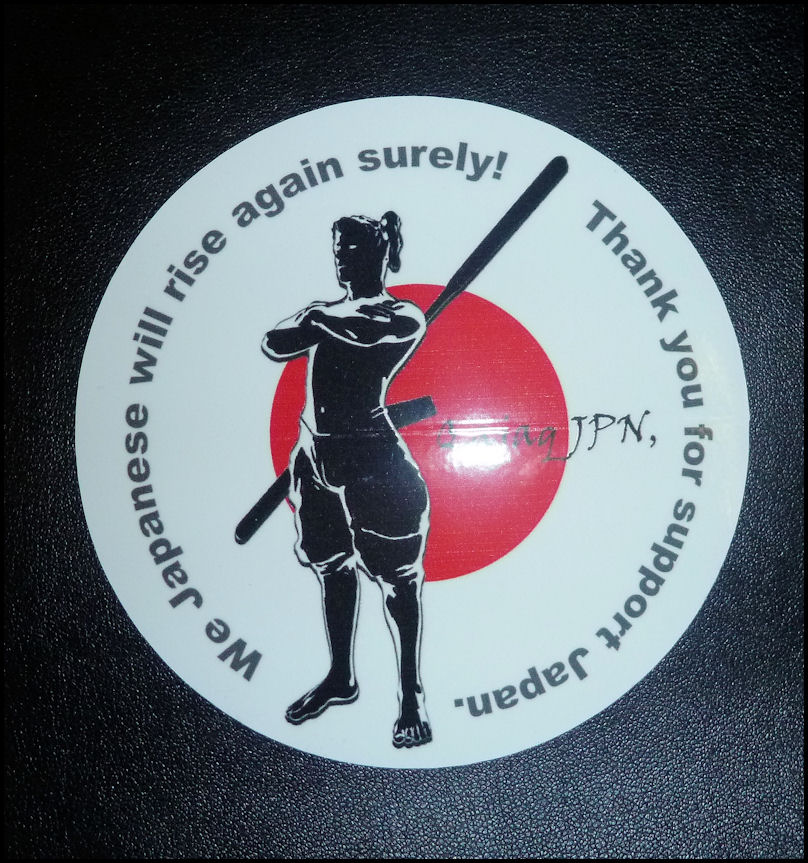
Stickers produced by Qajaq Japan to raise funds
for the victims of the earthquake & tsunami.
After the earthquake and Tsunami that struck Japan in March this year, GUTS2011 was made a charity event, raising desperately needed funds for the victims of the tragedy, making their theme for this year: Coexistence, Kayak and Sea. The culture and identity of Japan is so closely interwoven with the surrounding sea it is impossible to separate them. Those who spend time with the sea, either for pleasure or for work, gain a healthy respect for the power of the ocean, but when something this devastating strikes, it is hard to imagine living in harmony with such a force. The Sea surrounds us and supports us, it provides for us and, for an island nation, offers protection. It is all too easy to forget how important it is when it has delivered such a terrible blow to the very people who depend on it.
During the event, there was a talk and slide show given by Soma-San who worked as a volunteer in some of the stricken areas. To see even a fraction of the devastation witnessed by these people is heart breaking, to volunteer in such a situation takes enormous courage and strength and I greatly admire Soma and all the people who worked so hard to help those in need. The catch cry taken up by volunteer groups and fundraisers throughout Japan is the word “Kizuna” which in a rough translation means ‘strong bonds of friendship’, and Kizuna was a word we used often through the weekend, I felt honoured to be friends with such a great group of people.
Our bedroom for a few days - we stayed in the
library, while Helen had the principal's office.
With two typhoons sitting off the coast, we saw a lot of rain. Some plans were changed, but everything was kept rolling along smoothly. We stayed in an old school which was about 125 years old. After being closed down when it was down to only eight students, it is now rented from the local government and is the sight of a Nature School. Making it more interesting, all the old school equipment is still in place, complete with student’s artwork and photos on the walls, giving the impression that at any time a bell may ring and a crowd of laughing children are going to appear out of nowhere to attend their classes. We were told that sometimes people who attended here in their childhood still come back to visit and see their old school, revisiting fond memories of their school days.
Qajaq Japan has left its stamp here, with skin on frame kayaks suspended from the ceiling and a classroom converted to a boat building workshop, complete with notations and instructions on the blackboard. The gymnasium also made an excellent place to dry our gear on ropes stretched across the hall, and provided an indoor lecture room when the weather took a turn for the worse and one of our lessons became a theory class instead of braving the weather to get on the water again.
Beautiful Skin On Frame kayaks under construction.
The instructor for the event, and judge for the competition was Helen Wilson, who we had met just two weeks earlier at Thunder Bay in Canada. Lessons with Helen had been heaps of fun, and had helped me greatly with my progress, seeing me get my first Hand Rolls and Forward Finishing Rolls, with a number of variations thrown in. The Greenland interest is slowly growing in Australia, but it is not organised. With individuals or small groups scattered across the country exploring on their own, there is no one teaching these skills on a formal basis in Australia. Our trip gave me the opportunity to learn from some of the most dedicated teachers out there. I was looking forward to more lessons and fun with Helen.
Language of course, can often be a problem when travelling, but we were fortunate to have the help of Natalie, a translator working for the local government, who did an amazing job, and worked hard for the whole event. We also had help from Miklos, a Hungarian kayaker who teaches English studies at a university in Japan and was participating in GUTS. It is unfortunate, and a little embarrassing, that over the many years I have been interested in Japan, I have not been able to learn Japanese. It is almost impossible to find a teacher of any language unless you live near a city. If you live in a small town, you’re on your own. With a handful of phrases, a rather random selection of words, and a lot of martial arts terminology, it is frustrating to not know more. Each time I return from a trip to Japan, I have a renewed drive to learn this rich and complex language. In the meantime, we had the help of our translators, and a lot of patience and understanding from our Japanese friends.
Our first lessons and practice sessions took place on the beautiful Lake Ogawara. We were appointed to our teams by random draw and then hit the water for some lessons from Helen and a lot of practice to get the required rolls for the competition. These sessions were a lot of fun, with a wonderful, inclusive atmosphere. This wasn’t just an event for the experts but included paddlers of all skill levels with some getting their very first rolls during the weekend.
Participants practicing on the beautiful Lake Ogawara.
Instead of the whole rolling list, each team would demonstrate a set of three basic techniques, considered some of the most important ones, - The Standard Greenland Roll, Side Sculling, and the Storm Roll, with an additional two rolls randomly drawn from a list of more advanced techniques. I thought this was a wonderful idea as it encouraged everyone to take part. I was very fortunate with my draw, my team leader was none other than Eiichi Ito, president of Qajaq Japan; expert roller, boat builder and avid paddler. Now I was under pressure to lift my standard J Helen led a session on forward finishing rolls which helped me improve my storm roll, then we practiced with our teams.
Wayne, under Helen's expert guidance,
with Natalie standing by.
While Eiichi-san helped another team member with his rolls, he recruited Nao-san, last year’s champion, to help me. I was determined to get my elbow roll, one of the more advanced rolls (a variation on the hand roll with one hand held behind the head). With a couple of demonstrations, and a lot of expert assistance, I achieved my first Elbow Roll! Not satisfied with just one success, I spent the next 20 minutes or so practicing over and over again to make sure I had it.
Participants of GUTS 2011. Group photo at Lake Ogawara.
When we had first found out the event was to include a competition, we had thought maybe we could just go along as spectators. I still consider myself a newcomer to Greenland style kayaking, there would still be plenty to learn from watching the competition without the risk of embarrassing myself. We weren’t to be given that option. J After learning so much in Canada, I was feeling a little more confident, but our choice of rolls had me worried. Our draw had given us the Armpit Roll (one I can easily do) and the Brick Roll, having only gotten my hand roll two weeks previous this one had me nervous. I had done a hand roll with a small rock but the competition requirement of eight kg is a bit daunting.
Braving the rain, we all headed to the beach, the competition being held in the waves and swell of the ocean rather than the flat calm waters of the lake. Our turn came about all too soon and I jumped into my borrowed boat, not realising until I paddled away from shore that someone had shortened up the foot-pegs since the quick practice I had done earlier that morning. This made for a tighter fit and made the boat feel a lot more tippy as I paddled out into the waves.
Eiichi and I setting up for a roll.
Eiichi-san and I took up positions and awaited our signals from the beach, performing each of the rolls side by side (our other team member didn’t make it on this day so it was just the two of us). The first rolls went smoothly and it was now time for the moment of truth – The Brick Roll. When I first started in rolling and came across this in the ‘rolling list’, I thought it had to be a typo - 8kg seemed like a lot of brick. I was right about it being a big brick, wrong about the typo. The brick was delivered to me by a paddler waiting nearby. Eiichi directed him to give me the first attempt, I guess he already knew he could do it. My first problem was not the weight, I have really small hands – just gripping the brick was a challenge. I knew how the roll would work in theory, but theory is a bit different to sitting in a tiny boat in the waves holding eight kgs of brick and convincing yourself that you can roll back up. Fortunately the safety line attached to it was enough distraction for me, there was a long length of cord and a float attached to the brick so it could be retrieved if dropped.  I was paranoid about getting tangled in the rope midway through the roll, so I carefully ran the cord back and forth across the edge of the brick so it would come free if I did have to drop it, but would not be trailing through the water as I rolled.
The infamous 8kg Brick!
Source of much anxiety.
Without giving myself any more time to think about it, I positioned the brick, rolled in and was up and breathing again before I knew it. Holding the brick in the air in a victory salute would have had a great dramatic flair, and it is certainly what I felt like doing, but with such a tenuous grip on it, and the instability of my boat, I had to wait for the safety boat to come over and raft up before I could bring the brick back on the deck, I think my smile showed sufficient elation. Eiichi-san of course completed his roll smoothly and confidently, and we paddled back into shore to watch the remaining teams.
Many teams had drawn rolls that members couldn’t do, but they would still get points for the ones they did complete. It was great to see so many people willing to get out and give it a go, not concerned with winning, but just having fun, and giving each other support and encouragement. There were certainly more experienced rollers out there than me, but I was very lucky in both the team selection, and the rolls we were given. Eiichi-san and I were the winning team!
Eiichi Ito and myself. 2011 GUTS Champions.
Of course, not all of our time was spent rolling. There was a welcome banquet at a local restaurant with an amazing selection of Japanese food, local sight-seeing with many wonderful places to see, visits to onsen (Japanese bath houses), evening celebrations at the nature school (one evening leading to a series of ‘in-jokes’ about squid and rockets that has probably had a lot of people very confused since), an auction of goods to raise additional funds for the earthquake appeal, a BBQ feast at a local seafood market, and on our final day a paddle on Lake Towada – a beautiful lake in the crater of a volcano. The light rain, mist and clouds adding their own magic to the day. All of this added to an incredible experience with many, many fond memories.
Paddling with friends on the amazing Lake Towada.
The day of departure came and we were sad to have to say goodbye to our friends. Together with Helen, we rode on the Shinkansen back to Tokyo. Our first shinkansen ride had been at night and so there had been nothing to see outside except the occasional blur of lights as we sped past a city. This time we had daylight and were able to look out at the surrounding countryside as we zoomed past. It was sobering to see the many earthquake damaged buildings still waiting for repair, and the construction sites where buildings had been demolished, too damaged to be saved. So far from the epicentre, this was just a glimpse of the more minor damage that had been suffered.
As we drew closer to Tokyo, the weather worsened, the rain falling harder until any visibility beyond the train tracks was gone. We passed over rivers and creeks swollen with flood water, adding to our concern that Japan was to be hit by yet another blow from Mother Nature. A change of trains and we were on our way to the airport, making our farewells to Helen as we got off at our terminal. After wondering through the shops and taking our last chance for a Japanese meal. We settled down to watch the information boards. After seeing the steadily worsening weather as we travelled, we had our doubts about leaving on time.
Watching the red cancellations appear on the departures board.
As expected, the boards showed a steadily growing list in red of cancelled flights. When our flight came up, it was not with the cancellation notice that others had, but with “New Date” noted next to it. The typhoon had hit Tokyo and all flights were grounded. I quickly came to appreciate the difference between a quality airline and a budget one. We were given our boarding passes for our new flight leaving in the morning, an information sheet explaining everything, and were bussed to a hotel in Tokyo where we had a nice room provided, meal vouchers, and they even pre-booked our 4am wake up call. Those on the budget airline weren’t so fortunate. It was an interesting way for us to get an extra night in Japan J
The Japanese Red Cross are still running their appeal for the victims of the earthquake and tsunami, until March 2012. While the media may have moved on and forgotten about this great tragedy, there are still so many people in need. It will take Japan many years to recover, rebuilding takes time, but that is only one aspect. So many people have lost so much, not just their homes and possessions are gone, but whole communities have simply disappeared. So many people are alone, jobless and missing family and friends to support them as they face the challenge of rebuilding their lives. Please visit Japanese Red Cross at :http://www.jrc.or.jp/eq-japan2011/donation/l4/Vcms4_00002379.html and give your support.
Thanks go to Eiichi Ito, Takuma Togawa, Soma, Helen, Natalie, Miklos and all the other fantastic people of Qajaq Japan who gave us this amazing opportunity and an unforgettable experience.  KIZUNA J

Wednesday, 12 October 2011

A Beginning

Kayaking has long been a big part of our lives. When my husband and I were working 12 hour days, six days a week, it was almost guaranteed that on that one day off we could be found out there somewhere in our kayaks. For a long time it was all that was keeping us sane. No matter how our work week had been, we had the serenity and peace of the water awaiting us when Sunday swung round. After more than ten years of a work routine that was taking a higher and higher toll on us, we decided we had to change.  We made some drastic changes. We reduced our work load and our commitments. We moved house – away from our business; no longer just a ten minute drive away, we can’t be trapped into spending extra time there. We no longer work full time in the usual sense. On three days per week, we work long hours, the rest of the week is ours. Sounds great doesn’t it?
There were some sacrifices to be made to be able to work less and enjoy more. Less work does equal less money, we live a simple lifestyle so we can afford to do the things we love.  But the very fact that we can get out and enjoy ourselves bushwalking, cycling, snorkelling, kayaking and more, any time we want more than makes up for the things we do without. I have learned a very valuable lesson – Simplify! Demand less of life, and it will actually give you more.
The simple things are best!
Now we have a weekend, we can enjoy camping again
More about kayaking (or Qajaqing)
We have both always had a strong interest and appreciation of tradition and culture. Our love of Japanese Martial Arts led to a deep love of the ancient traditions and culture of Japan. It was only a matter of time before our passion for kayaking developed in the same way. For most people, they are happy enough to paddle their modern plastic or composite boats, with their fibreglass or carbon paddles and marvel over each new innovation modern technology brings to this sport. So many paddlers out there, and so few have ever spared a thought to where it all started. I have to admit, I was one of them. But as my interest deepened, I began to explore and learn more. Then Wayne bought a Greenland Paddle, I have to admit, after trying it a few times it didn’t win me over. I loved my big ‘Euro’ blades, and I certainly wasn’t convinced that this skinny little stick was going to give me the power to keep up with other paddlers. So Wayne started paddling with his skinny stick, while I kept my nice new fancy carbon fibre toy. For Wayne, the paddle did exactly what he had bought it for – after spending most of his life training in martial arts, along with a variety of other high impact activities, he has an impressive list of injuries – including major damage to both shoulders. The traditional paddle is espoused as a gentle paddle, one that will let you paddle for long days without the impact on the body that the big European blades can have. It performed as promised, but being younger, I was still happy with my ‘euro’.
My favourite Euro paddle- no longer in service.
Then, bored and housebound on a stormy weekend, we picked up a DVD that had been sitting on Wayne’s shelf for a while, neither of us had gotten around to watching it before. It was an instructional DVD on Greenland rolling. Watching this simple DVD was to going change my kayaking experience completely. Watching the rolls, and the simple exercises, I found myself thinking, ‘that looks easy, I can do that’. The next day saw us down on the water and me achieving my first ‘balance brace’. The following week it was out with the DVD again to brush up on the details then down to the water to get my first Greenland roll. There is something about Greenland rolling that resonated with me – for me, it made a lot more sense than the commonly taught ‘C to C roll’ that I had always had mixed results from. Suddenly, our kayaking had changed its nature. We had gotten into a pattern of long paddles and long days –we considered less than 6 hours on the water not worth getting the boats wet for. Now we were adding play sessions each weekend as well as our long distance cruises. I was amazed at how much fun could be had being upside down in the water. Greenland rolling is strangely addictive. Once you’ve cracked that first roll, you want to do more. I found myself happily spending hours on the water, not actually paddling anywhere, just rolling, bracing and playing for hours, adding more and more rolls to the repertoire. 

Side Sculling - one of my favourite techniques
After finding out just how easy it is to roll with a Greenland paddle, I started thinking more about paddling with one. To me, the GP represents tradition. Kayaking evolved in the Arctic Circle as vital hunting and survival skills. These tools were developed and perfected over thousands of years. If the skinny stick was considered the best tool for the job in those extreme conditions, then it was just insulting to reduce it to a plaything doing rolls as party tricks.
The paddle Wayne had been using was a commercially made two piece one. To me it always felt flimsy, it just didn’t give me the positive feel in the water that I liked from my euro.  Then I got my hands on a real GP. It was a beautiful work of art, hand crafted from Western Red Cedar, and custom made to my own measurements. The scent of cedar, and the warm glow of the natural wood finish just make you want to touch it. Then you just have to get it on the water. After my first paddle with it I was sold.  It paddled beautifully, giving me the power I liked in the water, as well as being light weight, highly manoeuvrable and very easy to control. I loved my euro paddles, and I had been through a number of them over the years before finding the perfect one for me, I haven’t picked up a euro paddle since that day. 
J
My first 'real' GP
This was when an opportunity fell into place and we took a big risk. We started up a new business and began importing Joe O’Blenis paddles from Canada. Our interest in Greenland paddling has been an amazing journey. As our interest deepened, we came to discover just how widespread the Greenland bug is. As a confirmed technophobe I was a reluctant convert to social media, but once there, I discovered an amazing online community of Greenland kayak enthusiasts. The internet has provided the opportunity for people from all over the world to freely share their experiences, give each other advice and encouragement, share a few laughs and welcome anyone who is interested into their world. Video clips are posted, questions asked, techniques and accomplishments shared, all without the ego and one-upmanship that you see in so many other sports. The thing that has impressed me most about this sector of the kayaking world is just how genuine its exponents are. It seems to attract a certain type – open, sharing, fun loving people who are eager to share with others.
I have to admit, our next big opportunity came from a Facebook conversation......